
PHRF Corrected Times—and the Fleet Champion Who Made Them Happen
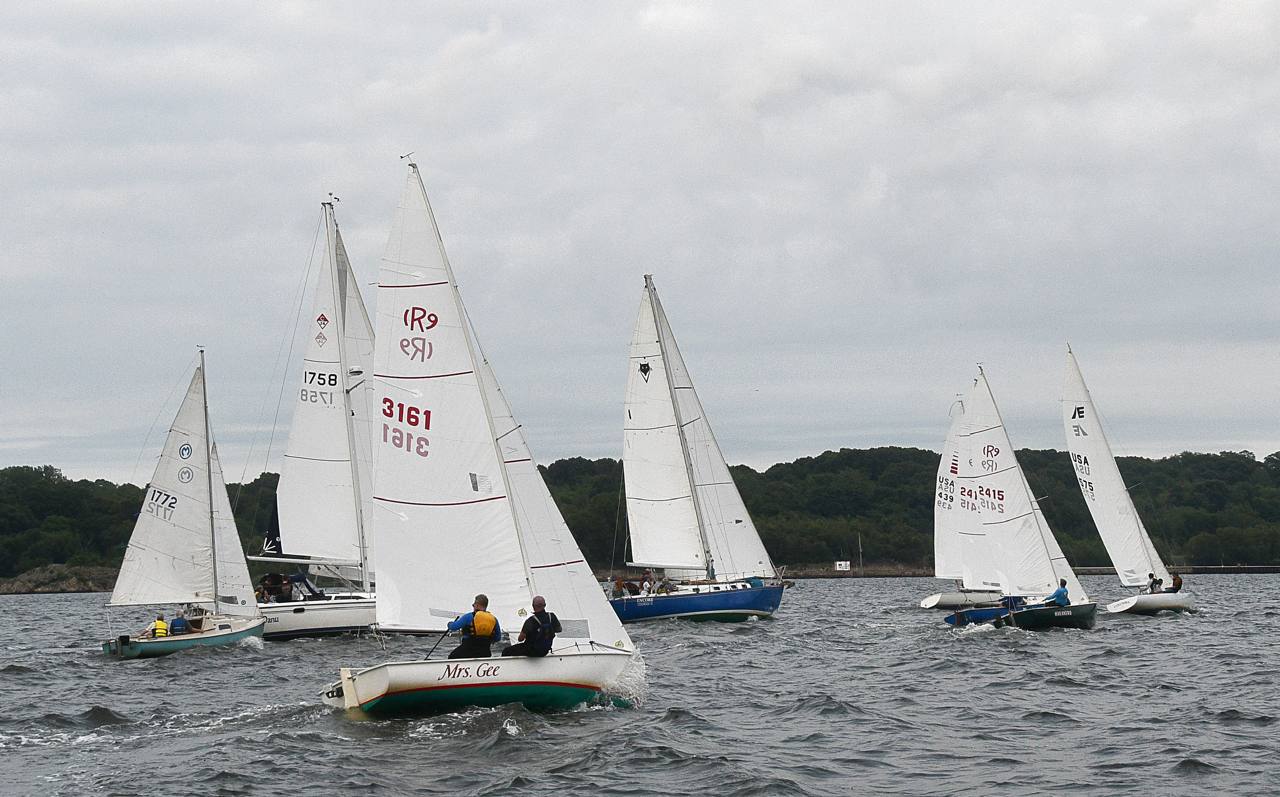 Edgewood Yacht Club's mixed fleet on the water.Photo courtesy of Katerina Stepanova.
For almost ten years, John Myers has done a job at Edgewood Yacht Club in Rhode Island that almost nobody sees.
In the early days it meant a drawer full of old iPhones. Before every race, John charged them, sealed each one in a waterproof case, and made sure they were recording. These days the hardware is smaller and purpose-built: little waterproof GPS loggers that clip to a life jacket. He hands them out on the dock, one boat at a time. After the racing is done, he collects every unit, downloads the tracks, and matches each one to the right boat and the right race.
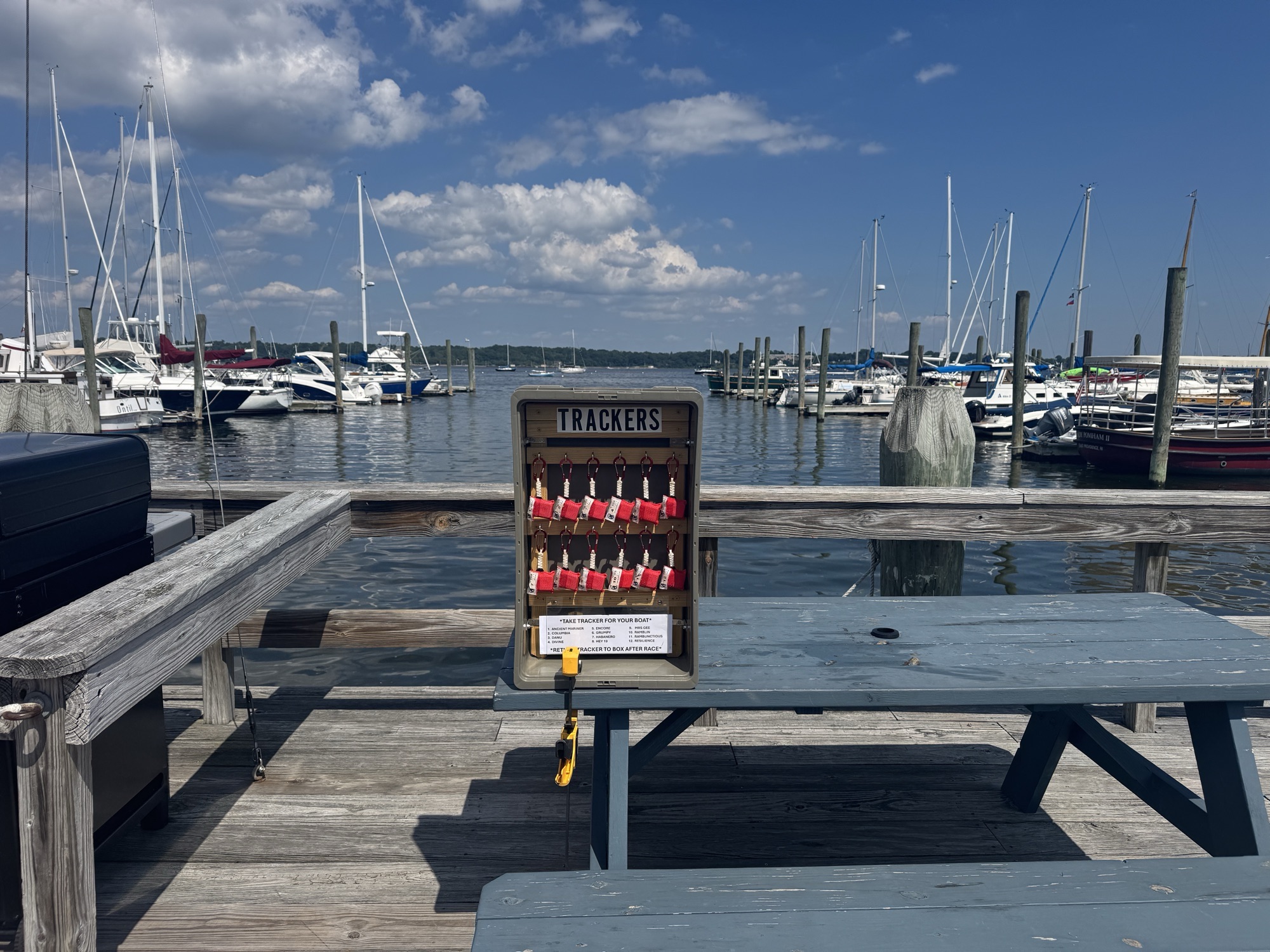
John's tracker kit at the dock: one labeled logger for each boat. Photo courtesy of John Myers.
None of that shows up in a highlight reel. But it's the reason his fleet gets to sit down after an evening of club racing and actually watch what happened.
A fleet replay takes a champion
I've come to believe something simple about club-level team and fleet sailing: the replay only exists because one person makes it exist. Someone charges the devices. Someone chases down the boat that forgot to start recording. Someone stitches the tracks together on Sunday night. Take that person away and the whole thing quietly stops.
So the way I see my job is straightforward. If a champion like John is going to keep doing that work, ChartedSails should make his life easier, not add to the pile.
John didn't start with ChartedSails. For years his fleet ran on RaceQs, and it worked well enough for a long time. But it grew progressively less reliable for him — tracks that didn't load, sessions that didn't come together the way they used to — and eventually he needed a replacement he could count on week after week. That's when we started talking.
What he wanted the tool to protect was the payoff, not the plumbing. When his fleet gathers around the race report, the conversation gets specific fast: who was pointing higher upwind, who saw the wind shift first, who made the tactical call that paid at the top mark. At one debrief the group even worked through a leg with sailing tactician and author Dave Perry in the room — the kind of session where a clear replay is the difference between "I think I was faster" and seeing exactly where the gain came from.
That's the thing worth protecting. Everything else is logistics.
A fleet that doesn't have to standardize
One of the first things John and I sorted out was that his fleet doesn't all record the same way — and it doesn't need to.
He can keep handing out the club's shared loggers to the boats that need them. At the same time, he can encourage the sailors who already carry their own hardware — a phone running the ChartedSails app, a Garmin watch, a Vakaros Atlas, a Velocitek ProStart — to contribute their tracks directly. ChartedSails imports the common GPS files those devices produce, so a boat with its own gear can just send in a file after racing instead of borrowing a unit.
That flexibility matters for a fleet like John's, which is bigger than any single session. The Club plan supports up to 12 boats per session, and he can rotate which boats and crews take part from week to week — mixing shared loggers and personal devices however each weekend shakes out. If you're wondering what counts as a usable track, we wrote up eight ways to record GPS tracks of your sailing — most of them drop straight into a ChartedSails session.
The question elapsed time couldn't answer
For a PHRF fleet, though, there was still a gap.
ChartedSails could already show every boat's track, speed, maneuvers, and elapsed time to the second. But PHRF racing is handicap racing — the boat that crosses the line first hasn't necessarily won. The question that actually matters is: after the correction, who won? And for that, John was still doing the math outside of ChartedSails.
On July 12, he asked me directly whether ChartedSails could show corrected times in the race reports. At the time, the honest answer was no. It stuck with me, though, and after a call on August 1 I sat down and built it.
Here's what it does now. In the session setup, you enter a PHRF rating for each boat — one number, the same rating your fleet already uses. Our step-by-step guide explains how to set up PHRF corrected-time scoring. From there the finishing table does the rest, showing each boat's elapsed time, its rating, and its corrected time, calculated with the US Sailing recommended time-on-time formula:
corrected time = elapsed × (650 ÷ (550 + rating))
The 650 and 550 constants are the recommended defaults, and they're configurable if your club uses regional values. When every finisher in a race has a rating, the table sorts by corrected time and the Delta column compares corrected results — which is what RRS Appendix A, Rule A3 calls for when a handicap system is in use. If only some boats are rated, the corrected column still appears for those boats, but the ranking stays on elapsed time so you're never shown a misleading partial result.
When John saw it, his reply was:
"The corrected times look great! Thank you so much."
That reaction is the whole reason I do this. A champion asked for a specific thing that would make his weekend easier, and a few weeks later it was in his hands.
If you run a PHRF fleet
If your club races PHRF and someone in your fleet is already doing John's job — charging the devices, collecting the tracks, making the replay happen — this is for you, and it's meant to give that person one less spreadsheet to keep.
PHRF corrected times are part of the Club plan, which supports up to 12 boats per session.
And if you're setting this up for your own fleet — or you just want to tell me what your version of John's drawer-full-of-iPhones looks like — reply here or email me at thomas@chartedsails.com. I read every one.
thomas